



Information on Aluminum Recycling
Why aluminum recycling is so energy-efficient
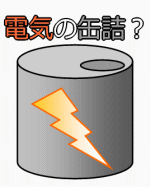
Aluminum recycling can be carried out using only about 3% of the energy required to refine aluminum from bauxite, allowing a 97% reduction in energy consumption.
The reason such a large reduction is possible lies in the nature of bauxite itself.
Aluminum is produced by extracting alumina from bauxite and then passing it through an electrolytic process.
This electrolytic process requires an enormous amount of electrical energy so much so that aluminum is often described as "electricity in a can."
Compared with metals such as iron, the process is significantly less energy efficient.
In nature, aluminum exists in a state where it is strongly bonded with oxygen and various other substances.
During the electrolytic process, powerful electrical energy is used to forcibly break these bonds and produce pure aluminum.
In contrast, recycling generally does not require this electrolytic process.
As long as the alloy composition can be precisely adjusted, aluminum can be recycled.
Problems with aluminum can recycling
When recycling aluminum cans, any debris or other items left inside can interfere with the material sorting process and, in some cases, may prevent the cans from being recycled. Furthermore, if items such as aerosol cans which are not processed alongside aluminum cans are mixed in, they can cause unexpected accidents, such as explosions. When collecting aluminum cans, please help us by separating them from steel cans and ensuring they do not contain any impurities or hazardous materials.
A missile?! Aluminum scrap other than aluminum cans
When people think of aluminum scrap, aluminum cans are relatively well known, but many other types of scrap also serve as raw materials for recycled aluminum ingots.
Examples include power transmission lines, automotive parts and construction waste.
In addition, there are countless aluminum based products such as household pots and pans, computer components, and more.
Among the more unusual items are airplane scrap and even fragments of missiles.
Our factory’s storage area sometimes feels almost like a museum.
Aluminum melts too, though only at very high temperatures.
When producing recycled aluminum ingots, the aluminum is first melted, impurities are removed, and the chemical composition is adjusted. During this process, the temperature exceeds 600 degrees and can reach nearly 700 degrees. Inside the furnace, the aluminum becomes molten and, due to the extremely high temperature, looks almost like lava. For reference, some metals require even higher temperatures to melt: iron melts at around 1500°C, and tungsten, which is used in light bulbs, does not melt until it exceeds 3400 degrees.